Why Food Safety Matters in Meal Prep
When you cook meals in batches to fuel your training, you are also handling food that will be eaten over several days. That makes safe storage practices essential. The USDA states that perishable foods should be refrigerated within two hours of cooking, or within one hour if the temperature is above 90°F. This window is meant to keep food out of the danger zone.
Bacteria multiply rapidly between 40°F and 140°F. Keeping your refrigerator at 40°F (4°C) or lower and your freezer at 0°F (-18°C) slows that growth and helps your carefully prepared meals stay safe to eat.
- Refrigerate cooked food within 2 hours (1 hour in hot weather).
- Keep your fridge at or below 40°F and your freezer at 0°F.
- Cool large batches quickly using shallow containers.
- Label every container with the date before storing.
Sources: Food Poisoning News, Michigan State University Extension
Refrigerator Storage Times for Common Foods
For typical prepped proteins and grains, you have a short window in the refrigerator. Cooked chicken, beef, and grains are safe for 3–4 days when kept at or below 40°F. Soups and casseroles may hold up to 4–5 days, but the safest approach is to eat them within the shorter window whenever possible.
| Food type | Storage time |
|---|---|
| Cooked chicken, beef, grains | 3–4 days |
| Soups and casseroles | 4–5 days |
Sources: Food Poisoning News, ID Times
Freezer Storage Times for Prepared Meals
Freezing is a great way to extend the life of your meal prep beyond a few days. In general, frozen leftovers keep their safety for 3 to 6 months, depending on the dish and how well it was wrapped. For best quality, aim to eat frozen meals within that range, though they remain safe indefinitely if kept at a constant 0°F.
- Most prepped meals are safe for 3–6 months in the freezer.
- Use airtight, moisture-proof containers or freezer bags.
- Label each package with the date before freezing.
Sources: ID Times
Safe Thawing Methods
The way you thaw your frozen meals matters. The safe methods are: in the refrigerator, under cold running water, in the microwave using the defrost setting, or as part of the cooking process. Never thaw on the counter at room temperature, as the outer layers can enter the danger zone while the center is still frozen.
For meal prep, the easiest plan is to move a container from the freezer to the refrigerator the night before you plan to eat it.
- Refrigerator thawing: plan ahead, requires overnight.
- Cold water thawing: place sealed bag in cold water, change water every 30 minutes.
- Microwave thawing: use the defrost setting and cook immediately after.
- Cook directly from frozen when your recipe allows, increasing cooking time.
Sources: Food Poisoning News, Michigan State University Extension
Reheating Temperatures for Different Foods
When reheating your prepped meals, the goal is to kill any bacteria that may have grown during storage. The safe benchmark is to heat all leftovers to an internal temperature of at least 165°F (74°C). Use a food thermometer to check the center of the dish, not just the edges.
- Reheat all meal prep to 165°F (74°C) before eating.
- Stir or rotate food during microwaving for even heating.
- Do not reheat food more than once; instead, reheat only the portion you plan to eat.
Sources: Clean Eatz Kitchen, Table and Spoon, CyCookery
Preventing Cross-Contamination
Cross-contamination happens when bacteria from raw foods spread to ready-to-eat items. To prevent it, use separate cutting boards for raw meats and for foods you will eat without cooking, such as vegetables or cooked meals. Also, store raw meats on the bottom shelf of your refrigerator and cooked or ready-to-eat items on shelves above them, so any drips cannot contaminate your prepped meals.
- Use separate cutting boards for raw meat and ready-to-eat food.
- Store raw meats on the bottom refrigerator shelf.
- Keep cooked meals on upper shelves, away from raw meat juices.
- Wash hands, utensils, and surfaces after handling raw meat.
Sources: Food Poisoning News, Michigan State University Extension
Labeling and Dating Prepped Meals
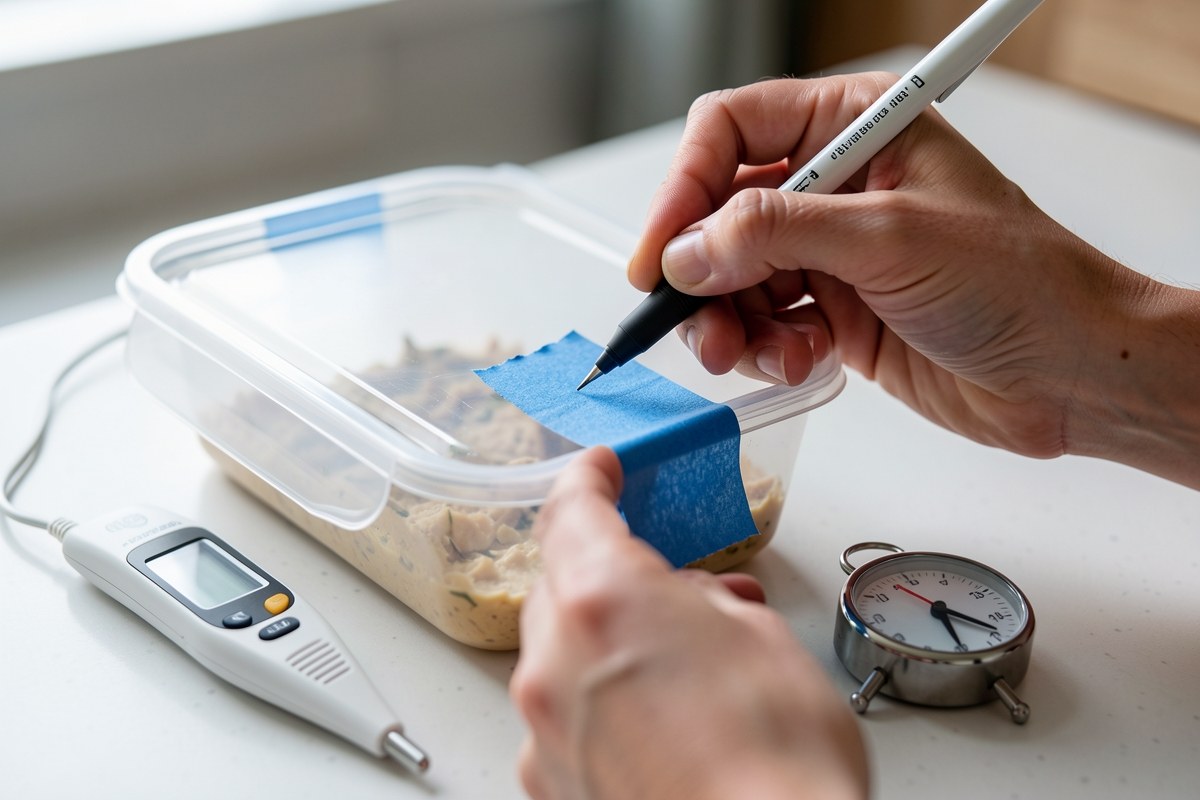
Labeling and dating your containers is a simple habit that pays off. By knowing when you cooked a meal, you can track how long it has been stored and eat it before safety limits pass. Write the date on the container with tape or a permanent marker, and include what is inside if the container is not clear.
- Label every container with the date prepared.
- Write a short description if the container is not transparent.
- Follow the rule: first in, first out. Eat older meals first.
- When in doubt, throw it out.
Sources: Michigan State University Extension
Frequently asked questions
How long can prepped chicken stay in the fridge?
Cooked chicken is safe for 3–4 days when refrigerated at or below 40°F. After that, throw it out to avoid foodborne illness.
Sources: Food Poisoning News, ID TimesCan you freeze meals in glass containers?
Yes, you can freeze meals in glass containers as long as they are labeled freezer-safe. Leave some headspace to allow for expansion, and cool the food before freezing to reduce condensation and potential breakage.
Sources: Clean Eatz KitchenIs it safe to reheat food more than once?
It is safest to reheat food only once. Repeated reheating increases the time food spends in the danger zone and can degrade quality. Instead, reheat only the portion you plan to eat and store the rest in the refrigerator.
Sources: CyCookeryWhat is the best way to thaw frozen meal prep?
The best way is to thaw in the refrigerator overnight. If you need a faster method, you can use cold running water or the microwave defrost setting, but cook the food immediately after thawing. Never thaw on the counter.
Sources: Food Poisoning News, Michigan State University ExtensionHow can I tell if prepped food has spoiled?
Look for signs like an off smell, slimy texture, or visible mold. Trust your senses: if it looks or smells different from when you prepared it, discard it. Even if it looks fine, if it has been in the fridge longer than the recommended 3–4 days, it is safer to throw it out.
Sources: Food Poisoning News, ID TimesSources
- Meal Prep Safety: How to Store, Reheat, and Handle Food for Maximum Freshness — Food Poisoning News
- Meal Prep Food Safety: How Long Cooked Food Actually Lasts — ID Times
- Complete Meal Prep Guide — Clean Eatz Kitchen
- Reheating Meal Prep: Safety, Nutrition, and Best Practices — Table and Spoon
- Reheating And Refrigerating Food: Safe Practices To Prevent Spoilage — CyCookery
- Are you using these safe food handling procedures? — Michigan State University Extension